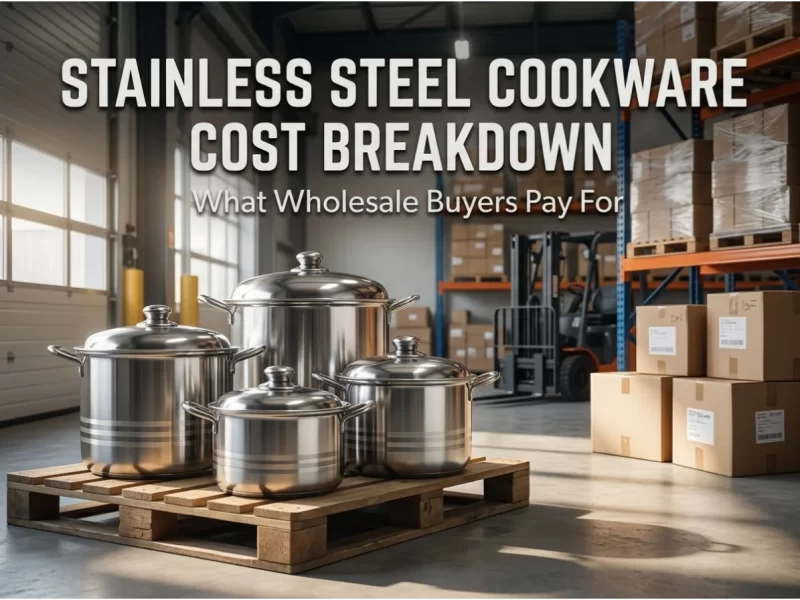
Utensílios de cozinha em aço inoxidável cost depends on steel grade, material thickness, manufacturing processes, product construction, customization, and order volume. For wholesale buyers, comparing these factors is essential to evaluating supplier quotes and controlling total purchasing costs. Allnice provides OEM/ODM cookware manufacturing, customization, and bulk supply solutions for global buyers.
What Factors Determine Stainless Steel Cookware Cost?
The main factors determining stainless steel cookware cost are raw materials, product specifications, manufacturing complexity, finishing requirements, and order quantity. Each factor contributes differently depending on the cookware design and production requirements.
1. Raw Material Grade: 201 vs. 304 Stainless Steel
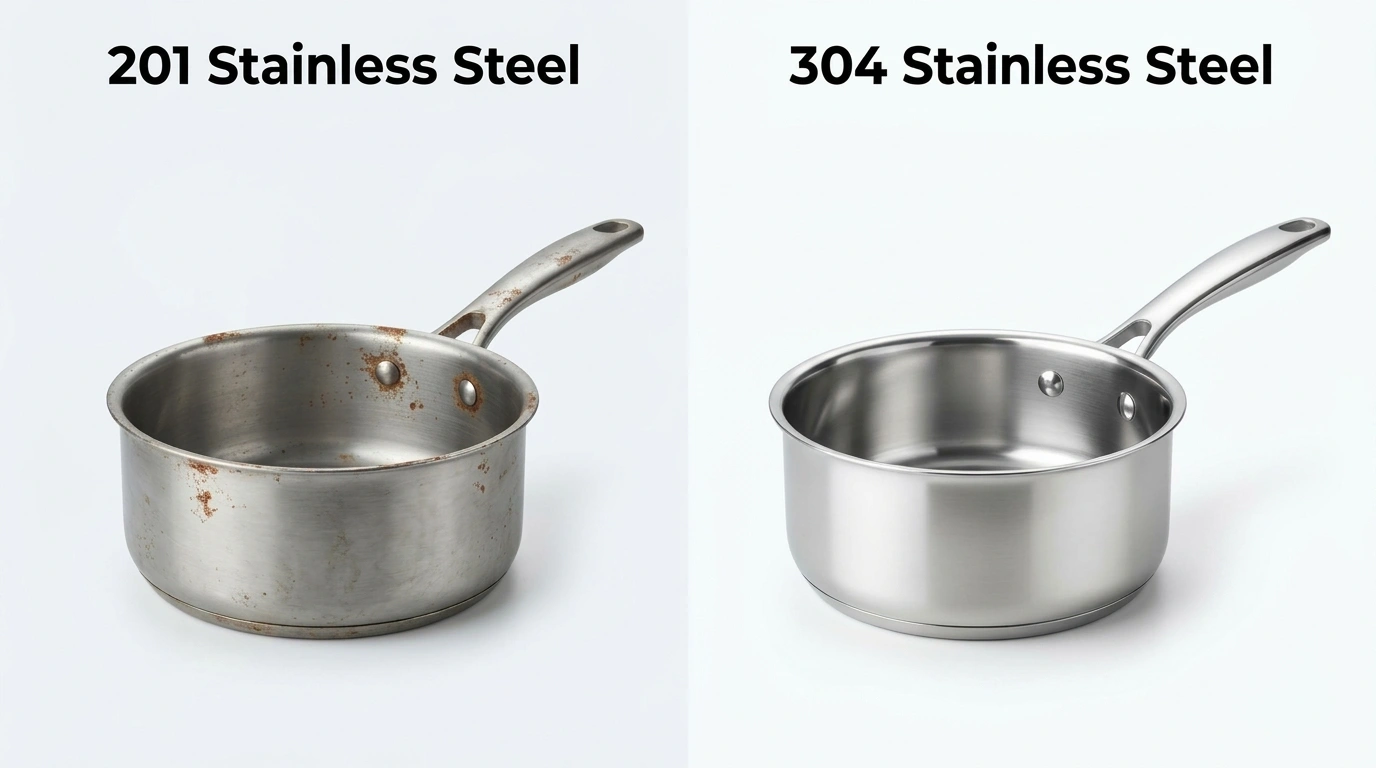
Stainless steel grade is one of the most important cost drivers because different grades have different chemical compositions, corrosion resistance, and material prices.
For example, 304 stainless steel typically contains approximately 18% chromium and 8% nickel. Its corrosion resistance, formability, and weldability make it widely used in kitchen equipment and food-related applications.
201 stainless steel uses a different alloy composition and generally contains less nickel. It can offer a lower material cost, but its corrosion resistance differs from 304.
| Comparação | Aço inoxidável 201 | Aço inoxidável 304 |
|---|---|---|
| Nickel content | Inferior | Mais alto |
| Resistência à corrosão | Moderado | Mais alto |
| Custo dos materiais | Geralmente mais baixo | Geralmente mais elevado |
| Common consideration | Cost-sensitive products | Premium cookware applications |
| Purchasing priority | Budget positioning | Durability and performance |
Buyers should select the grade according to the product’s intended use, market positioning, and performance requirements rather than choosing materials based on price alone.
2. Material Thickness and Cookware Construction
Material thickness directly affects the amount of stainless steel required for each product. A thicker body generally requires more raw material and may involve additional forming effort.
Cookware construction also influences the stainless steel cookware cost. Common configurations include:
- Single-layer stainless steel construction.
- Impact-bonded or encapsulated base construction.
- Multi-layer construction with aluminum or other conductive core materials.
For example, a basic stainless steel saucepan and a multi-layer stainless steel stockpot may have different material requirements, production processes, and performance specifications.


When requesting quotations, buyers should specify body thickness, base construction, diameter, capacity, and weight. These details make supplier quotations more comparable.
3. Manufacturing Processes and Labor Costs
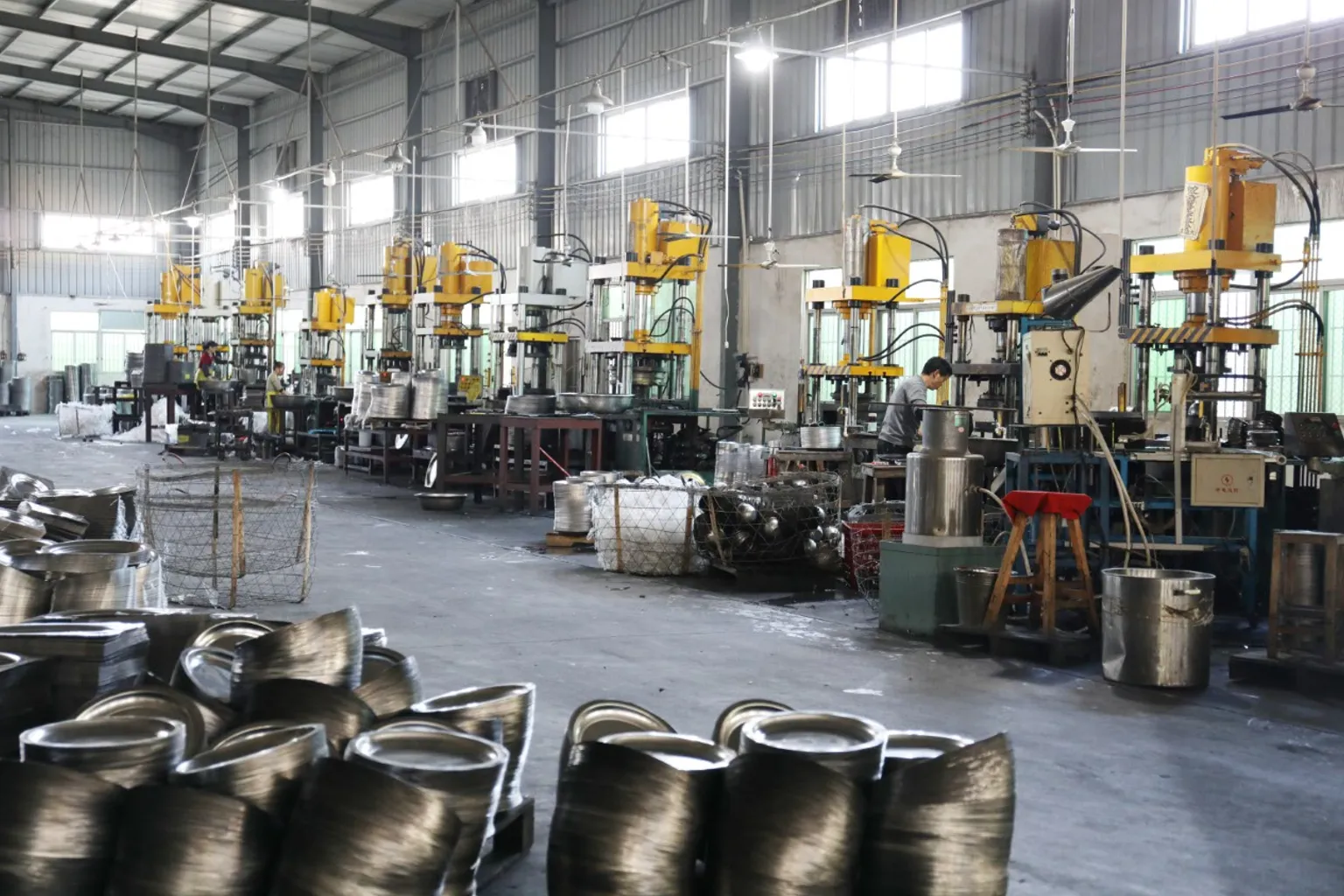
Manufacturing complexity affects production time, equipment requirements, labor input, and material utilization.
Typical cookware manufacturing processes include cutting, stamping, deep drawing, trimming, welding, assembly, polishing, and inspection.
A simple stainless steel bowl may require fewer processing steps than a cookware set containing multiple pots, lids, handles, and specialized base structures.
Production efficiency also matters. Automated equipment, optimized production layouts, and standardized components can reduce processing time and improve manufacturing consistency.
4. Surface Finishing and Product Components
Surface finishing and accessories contribute to the final product cost.
Mirror polishing requires additional finishing work to achieve a reflective appearance, while brushed finishing creates a directional surface texture. Different finishing requirements result in different processing times and quality-control needs.
Other components that influence pricing include:
- Stainless steel or other specified handles.
- Glass or stainless steel lids.
- Rivets, screws, and connecting components.
- Knobs and handle fittings.
- Measurement markings and decorative details.
Buyers should evaluate these components as part of the complete product specification instead of comparing cookware bodies alone.
What Additional Costs Should Wholesale Buyers Consider?
Wholesale buyers should account for customization, tooling, packaging, quality assurance, logistics, and import expenses in addition to the factory production price. These costs determine how much a buyer actually spends before products reach the warehouse.
1. OEM/ODM Customization and Tooling
OEM and ODM projects may involve additional development and customization expenses.
Common requirements include:
- Custom product dimensions and structures.
- Logo engraving, printing, or embossing.
- Customized handles and product components.
- New molds or modifications to existing molds.
- Product samples and design adjustments.
The stainless steel cookware cost of a customized project depends on the extent of development required. Using an existing product design with a customized logo generally involves fewer development requirements than creating an entirely new cookware structure.
Before placing an order, buyers should confirm whether mold costs are charged separately, whether sample fees are refundable, and whether tooling ownership is clearly defined.
2. Packaging and Branding Expenses
Packaging is another important consideration for wholesale and private label projects.
Standard export cartons, individual product boxes, customized color boxes, inserts, labels, and protective materials all contribute to packaging expenses.
| Packaging Type | Typical Application | Cost Consideration |
|---|---|---|
| Export carton | Bulk transportation | Protection and carton specifications |
| Individual box | Retail distribution | Printing and material selection |
| Caixa de cor | Branded cookware products | Artwork and printing |
| Caixa de oferta | Premium cookware sets | Structure and finishing |
| Custom inserts | Product protection | Material and design complexity |
For private label brands, packaging should match the target retail market and product positioning. Excessive packaging increases purchasing expenses without necessarily improving the product’s commercial value.
3. Quality Control and Compliance Requirements

Quality control should be included in the procurement budget because it protects buyers against defects, inconsistent specifications, and costly product returns.
Relevant inspection points include material verification, dimensional accuracy, surface finish, handle attachment, lid fitting, and packaging condition.
Food-contact compliance also matters when selling cookware internationally. For example, the European Commission explains that food-contact materials placed on the EU market must comply with Regulation (EC) No 1935/2004 and applicable good manufacturing practice requirements under Regulation (EC) No 2023/2006.
Buyers should identify applicable destination-market requirements before production and request relevant supporting documentation from their suppliers.
4. Shipping, Insurance, and Import Expenses
The factory quotation is not necessarily the final purchasing cost.
International procurement may involve freight, cargo insurance, customs duties, import taxes, customs clearance, port handling, and domestic transportation.
The allocation of transportation and other trade-related costs depends on the agreed Incoterms rule. The International Chamber of Commerce provides 11 Incoterms 2020 rules that define the responsibilities, costs, and risk allocation between buyers and sellers.
Buyers should compare quotations using the same delivery terms rather than comparing an EXW price directly with a DDP price.
Why Do Stainless Steel Cookware Wholesale Prices Vary Between Suppliers?
Stainless steel cookware wholesale prices vary because suppliers may use different material specifications, production methods, quality standards, sourcing arrangements, and order calculations. A lower quotation does not automatically represent better purchasing value.
Consider the following comparison:
| Pricing Factor | Supplier A | Supplier B |
|---|---|---|
| Material | Aço inoxidável 304 | Aço inoxidável 304 |
| Espessura do corpo | As specified | Different thickness |
| Construção | Multi-layer base | Standard base |
| Acabamento da superfície | Mirror polished | Basic polished |
| Acessórios | Customized handles and lids | Standard components |
| Embalagem | Custom retail packaging | Export carton |
| Controlo de qualidade | Defined inspection requirements | Basic inspection |
Even when two products look similar in photographs, their manufacturing costs can differ substantially.
A useful way to evaluate the stainless steel cookware cost is to request a detailed quotation breakdown from each supplier. Ask manufacturers to identify material specifications, product weight, construction, finishing, accessories, packaging, and inspection requirements.
This approach helps buyers identify whether a price difference comes from genuine product improvements or simply different quotation assumptions.
Market conditions also influence procurement budgets. According to the World Stainless 2025 production report, global stainless steel melt shop production reached 64.2 million metric tonnes in 2025, increasing by 2.1% year over year.
The U.S. Bureau of Labor Statistics also tracks steel mill product prices through its Producer Price Index. Its September 2026 data reported an index of 388.580 for steel mill products, compared with 349.997 in May 2026. This is a general steel-industry indicator, not a stainless cookware quotation index, but it demonstrates why buyers should confirm material pricing and quotation validity before placing orders.
How Can Wholesale Buyers Calculate the Total Purchasing Cost?
Wholesale buyers can calculate total purchasing cost by adding the factory product price, customization expenses, packaging, inspection, transportation, insurance, and applicable import charges. Dividing the total by the quantity of saleable products gives the landed cost per unit.
A practical calculation is:
Total Purchasing Cost = Product Cost + Customization + Packaging + Inspection + Freight + Insurance + Import Duties and Taxes + Other Applicable Charges
Landed Cost per Unit = Total Purchasing Cost ÷ Saleable Quantity
For example, consider a hypothetical order of 2,000 stainless steel cookware sets.
| Cost Item | Example Amount (USD) |
|---|---|
| Product manufacturing | $30,000 |
| Customization and tooling | $1,000 |
| Embalagem de retalho | $2,000 |
| Inspection and documentation | $500 |
| Freight and insurance | $3,500 |
| Import duties and other charges | $3,000 |
| Total purchasing cost | $40,000 |
The landed cost is:
$40,000 ÷ 2,000 = $20 per saleable set
These figures are illustrative only, not actual Allnice quotations or industry averages. Actual costs depend on product specifications, shipping arrangements, destination-country regulations, and order conditions.
An accurate stainless steel cookware cost calculation should also account for rejected products, replacement requirements, and expected warehouse handling expenses when these are relevant to the project.
How Can Buyers Reduce Stainless Steel Cookware Purchasing Costs?
Buyers can reduce procurement expenses by optimizing product specifications, consolidating orders, standardizing components, and working with capable manufacturers. The objective is to lower unnecessary costs without compromising product performance or quality.
Five practical strategies can help:
- Choose suitable material grades. Match stainless steel specifications to the intended application and target market instead of automatically selecting the most expensive material.
- Optimize product construction. Select appropriate body thickness, base structures, and components based on performance requirements. Avoid unnecessary design complexity.
- Consolidate bulk orders. Combining compatible products into larger production orders can improve manufacturing efficiency and reduce repeated setup and procurement expenses.
- Standardize components and packaging. Using shared handles, lids, and packaging dimensions across product ranges can simplify sourcing and inventory management.
- Work directly with an experienced manufacturer. A qualified stainless steel cookware supplier can coordinate product development, manufacturing, quality inspection, and customization, reducing communication gaps and unnecessary sourcing costs.
Buyers should evaluate cost savings alongside product consistency, delivery reliability, and after-sales support. The lowest factory price is not necessarily the lowest total purchasing cost.
O que devem os compradores incluir num pedido de cotação para utensílios de cozinha em aço inoxidável?
A complete Request for Quotation (RFQ) should specify product requirements, materials, quantities, customization, packaging, quality standards, and delivery terms. Clear specifications allow manufacturers to provide accurate and comparable quotations.
Before contacting a fornecedor de utensílios de cozinha em aço inoxidável, prepare the following information:
- Product details: Product type, dimensions, capacity, and intended application.
- Material specifications: Stainless steel grade, thickness, and construction.
- Product components: Handles, lids, fittings, and other accessories.
- Surface finishing: Mirror polish, brushed finish, or other requirements.
- Customization: Logo, product design, molds, and private label requirements.
- Order quantity: Estimated volume, MOQ expectations, and repeat-order plans.
- Embalagem: Individual boxes, retail packaging, export cartons, and labeling.
- Quality requirements: Inspection criteria, testing, and destination-market compliance.
- Shipping terms: Destination port, delivery location, and preferred Incoterms.
- Timeline: Sample approval, production schedule, and expected delivery date.
Providing these details helps manufacturers understand the project and reduces quotation revisions caused by missing information.
Perguntas frequentes
1. What is the biggest factor affecting stainless steel cookware cost?
Raw material grade, material weight, product construction, and manufacturing complexity are major cost drivers. Their relative importance depends on the specific cookware design and production requirements.
2. Is 304 stainless steel cookware more expensive than 201?
Generally, yes. 304 stainless steel contains more nickel and offers higher corrosion resistance than 201, which usually makes it more expensive. Actual price differences depend on current material markets and product specifications.
3. Does buying stainless steel cookware in bulk reduce the unit price?
Yes, larger bulk orders directly lower the per-unit stainless steel cookware cost through improved material purchasing, production scheduling, and packaging efficiency. However, the actual savings depend on MOQ, product complexity, and order configuration.
4. How does OEM customization affect stainless steel cookware cost?
OEM customization can increase costs through mold development, sample production, logo application, design adjustments, and customized packaging. The impact depends on whether existing designs or entirely new product structures are required.
5. How can I compare quotations from different cookware suppliers?
Request quotations based on identical material grades, thicknesses, product dimensions, construction, accessories, finishing, packaging, inspection requirements, and Incoterms. Comparing identical specifications provides a more reliable assessment of supplier pricing.
6. How can I get a competitive wholesale cookware quotation?
Prepare a detailed RFQ covering product specifications, materials, order quantities, customization, packaging, and delivery requirements. Working directly with an experienced manufacturer also helps buyers coordinate production and evaluate the full purchasing cost.
Conclusão
Understanding stainless steel cookware cost is essential for making informed purchasing decisions, protecting profit margins, and building reliable long-term supply relationships. Wholesale buyers should look beyond the factory unit price and evaluate material specifications, manufacturing processes, customization, packaging, quality control, and landed costs together. A transparent quotation based on clearly defined product requirements makes supplier comparisons more accurate and purchasing decisions more effective.
Allnice é um trusted cookware manufacturer especializado em utensílios de cozinha em aço inoxidável, loiça de mesae equipamento de restauração for global importers, wholesalers, distributors, and private label brands. With OEM/ODM capabilities covering product design, mold development, logo customization, and bulk production, Allnice provides one-stop kitchenware solutions supported by strong manufacturing capacity, strict quality control, and competitive pricing. Whether you are developing a new cookware collection or expanding an existing product line, contact Allnice today to discuss your requirements and request a competitive wholesale quotation.