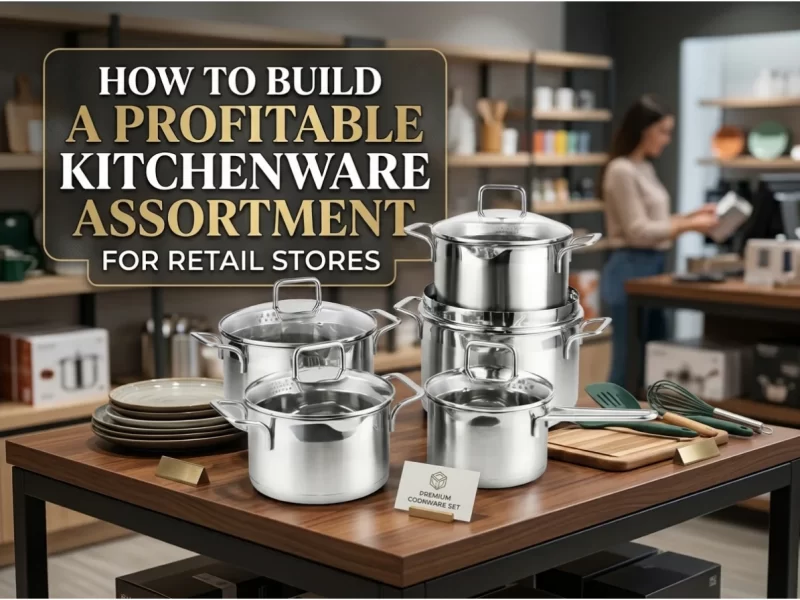
A profitable kitchenware assortment combines the right product categories, balanced price points, manageable SKU quantities, and reliable wholesale sourcing. Retailers should select products based on customer demand, sales potential, gross margins, and inventory turnover rather than simply stocking more items. Allnice, un experienced kitchenware manufacturer, supports global retailers, importers, and distributors with ustensiles de cuisine en acier inoxydable, vaisselle, matériel de restaurationet Solutions OEM/ODM.
This guide explains how to develop a commercially effective product mix and work with the right wholesale kitchenware manufacturer.
How Should Retailers Define Their Market Positioning?
Retailers should define their target customers, price positioning, and sales channels before selecting products. A clear market position determines which kitchenware categories to stock, how much customers are willing to pay, and which products deserve priority.
Different retail business models require different product strategies:
| Retail Positioning | Clientèle cible | Recommended Product Focus |
|---|---|---|
| Value-oriented stores | Budget-conscious households | Basic cookware, utensils, and kitchen accessories |
| Mid-range retailers | Everyday home cooks | Stainless steel cookware sets, frying pans, and tableware |
| Premium kitchenware stores | Quality-focused consumers | Premium cookware, coordinated collections, and serving products |
| Specialty stores | Customers with specific cooking needs | Professional cookware and specialized kitchen tools |
| Online kitchenware retailers | Comparison-driven shoppers | Complete product sets, versatile items, and complementary accessories |
Retailers should also evaluate local purchasing habits, household sizes, cooking preferences, and competitors’ product ranges.
Online sales deserve particular attention. According to the U.S. Census Bureau’s Quarterly Retail E-Commerce Report, e-commerce accounted for 17.1% of total U.S. retail sales in the second quarter of 2026 on a seasonally adjusted basis. This figure covers all retail categories, not kitchenware alone, but it demonstrates why retailers should consider online product presentation alongside physical store merchandising.
A clearly defined market position prevents retailers from purchasing unrelated products simply because they are available from a supplier.
Which Kitchenware Product Categories Should Retail Stores Include?
A balanced kitchenware assortment should cover essential cooking, food preparation, dining, and serving needs. Retailers should select complementary categories that encourage customers to purchase multiple products while maintaining a clear store identity.
Four product categories provide a practical starting point.
1. Stainless Steel Cookware
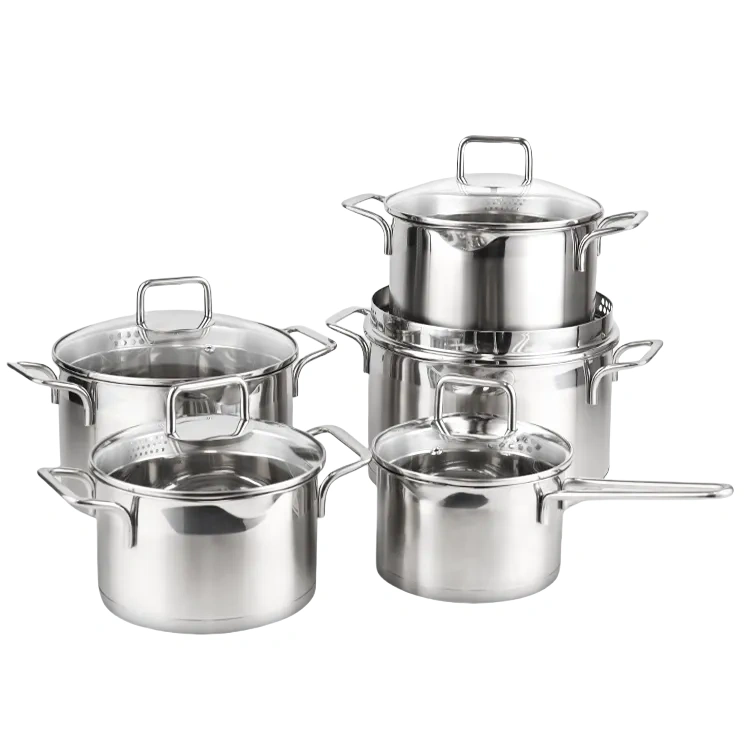
Cookware is a core category for most kitchenware retailers. Consider stocking:
- Poêles à frire et poêles à frire plates
- Saucepans and stock pots
- Casserole pots
- Multi-piece cookware sets
Offer different sizes and configurations to serve individual households, families, and customers upgrading their kitchens.


2. Kitchen Tools and Accessories
Kitchen tools complement cookware and provide accessible purchasing options. Suitable products include spatulas, ladles, tongs, whisks, turners, and measuring tools.
These products help retailers expand their selection without relying exclusively on higher-priced cookware.


3. Stainless Steel Tableware
Tableware extends the product range from cooking to dining. Consider stainless steel bowls, cutlery, serving trays, and serving utensils.
Coordinated products can create attractive collections and provide additional cross-selling opportunities.


4. Catering and Commercial Kitchenware
Retailers serving hospitality businesses, restaurants, and catering operators can expand into chafing dishes, buffet equipment, and commercial serving supplies.


These products create opportunities to serve professional buyers alongside household consumers.
The most effective kitchenware assortment connects these categories through shared customer needs. For example, a cookware set can be displayed with matching utensils and serving products to create a complete kitchen solution.
How Should Retailers Plan the Right SKU Mix?
Retailers should organize SKUs by product function, size, design, material, and price tier. The objective is to provide meaningful choices without creating unnecessary duplication or excessive inventory.
A practical SKU planning process includes five steps:
- Identify essential products: Start with items that meet frequent customer needs, such as frying pans, saucepans, and basic kitchen utensils.
- Add size variations: Offer practical options for different household sizes and cooking requirements.
- Introduce complementary products: Connect cookware with utensils, tableware, and serving accessories.
- Create clear price tiers: Provide entry-level, mid-range, and premium alternatives.
- Remove overlapping products: Avoid stocking several items with nearly identical functions unless customer demand justifies the difference.
Retailers can also classify products according to their commercial roles:
| SKU Role | Main Purpose | Example |
|---|---|---|
| Traffic drivers | Attract customers | Basic frying pans and kitchen utensils |
| Core sellers | Generate consistent sales | Everyday stainless steel cookware |
| Margin contributors | Support profitability | Premium cookware and coordinated sets |
| Basket builders | Encourage additional purchases | Ladles, tongs, and serving tools |
| Seasonal products | Capture specific demand | Holiday serving accessories |
One useful but often overlooked strategy is to evaluate SKU relationships rather than individual products alone.
For example, a frying pan may generate strong standalone sales, but its commercial value can increase when customers also purchase a matching spatula or cookware set. Retailers should therefore track both individual SKU performance and the additional sales generated by related products.
This approach creates a more commercially effective kitchenware assortment without requiring constant expansion of the total SKU count.
How Can Retailers Set Prices and Improve Profit Margins?
Retailers should set prices by considering landed product costs, operating expenses, competitor positioning, and customer willingness to pay. A profitable kitchenware assortment needs a balanced pricing structure rather than simply applying the same markup to every product.
Three price tiers are useful:
| Price Tier | Product Strategy | Retail Objective |
|---|---|---|
| Entry-level | Basic cookware and essential utensils | Attract price-sensitive buyers |
| Mid-range | Everyday cookware sets and tableware | Build a stable sales foundation |
| Premium | Higher-positioned cookware collections | Increase average transaction value |
Retailers should distinguish between markup and gross profit margin.
Gross Profit Margin Formula: Gross Profit Margin = (Selling Price − Cost of Goods Sold) ÷ Selling Price × 100%
For example, if a cookware set costs $40 and sells for $80, its gross profit is $40, and its gross profit margin is 50%.
However, retailers should also consider freight, import duties, packaging, warehousing, payment fees, and promotional discounts when calculating actual profitability.
A practical pricing strategy includes:
- Compare supplier quotations using the same specifications and order quantities.
- Calculate landed costs rather than relying only on factory prices.
- Maintain different price points for different customer segments.
- Bundle complementary products when the combined offer improves transaction value.
- Review margins regularly and adjust prices when purchasing costs change.
The best kitchenware assortment balances competitive retail prices with sustainable gross margins.
How Can Retailers Control Inventory and Avoid Overstocking?
Retailers can control inventory by monitoring sales velocity, stock levels, replenishment lead times, and product profitability. Regular SKU reviews help identify slow-moving products before they consume excessive storage space and working capital.
Use the following inventory management practices:
1. Apply ABC Inventory Analysis
Classify products according to their contribution to sales value or another clearly defined business metric.
- A-items: High-priority products requiring close monitoring.
- B-items: Medium-priority products requiring regular review.
- C-items: Lower-priority products that can use simpler replenishment controls.
2. Monitor Inventory Turnover
Inventory turnover measures how frequently stock is sold and replaced during a specific period.
Inventory Turnover = Cost of Goods Sold ÷ Average Inventory
A low turnover rate can indicate overstocking, weak demand, or an unsuitable product mix. A high rate may indicate strong sales, but retailers should also check whether frequent stockouts are limiting revenue.
3. Set Reorder Points
Calculate reorder points using average demand during supplier lead time and an appropriate safety stock allowance.
Reorder Point = Average Daily Demand × Lead Time in Days + Safety Stock
4. Review Slow-Moving Products
Identify products with low sales, overlapping functions, or declining customer interest. Reduce replenishment quantities and replace underperforming items with better-performing alternatives.
5. Plan Seasonal Purchases
Order seasonal kitchenware according to expected demand, supplier lead times, and previous sales records. Avoid placing large speculative orders without supporting demand data.
A further improvement is to connect product assortment decisions with replenishment risk. A product with an attractive margin may still be a poor inventory choice if its demand is unpredictable, its minimum order quantity is excessive, or its replenishment lead time is too long.
Retailers should evaluate margin, demand consistency, MOQ, and lead time together before expanding any product category.
How Should Retailers Choose a Reliable Wholesale Kitchenware Manufacturer?

Retailers should choose a manufacturer based on product quality, manufacturing capabilities, product range, customization services, pricing transparency, and long-term supply reliability.
A reliable wholesale partner can simplify purchasing and help retailers expand their kitchenware assortment without managing multiple disconnected suppliers.
Evaluate potential manufacturers using these criteria:
| Critère d'évaluation | What Retailers Should Check |
|---|---|
| Product range | Availability of cookware, tableware, kitchen tools, and catering products |
| Capacités de production | Production capacity and ability to handle bulk orders |
| Contrôle de la qualité | Material inspection, production checks, and finished-product inspection |
| Personnalisation | OEM/ODM, product design, logo, and packaging options |
| Pricing | Clear quotations, MOQ, and cost structure |
| Communication | Sample development, order updates, and after-sales support |
| Fiabilité de l'approvisionnement | Production lead times and repeat-order consistency |
Before confirming a bulk order, retailers should request product samples, verify specifications, review packaging requirements, and clarify acceptable quality standards.
They should also confirm whether the supplier can support future product development. A manufacturer offering OEM/ODM services can help retailers create differentiated products, coordinate product collections, and develop private-label ranges.
Working with a manufacturer that supplies multiple kitchenware categories can also simplify supplier management, quotation comparisons, and purchasing coordination.
Foire aux questions
1. What Is a Kitchenware Assortment?
A kitchenware assortment is the collection of cookware, kitchen tools, tableware, and related products offered by a retailer. It is planned around customer demand, product categories, price points, and sales objectives.
2. How Many SKUs Should a Kitchenware Retail Store Carry?
There is no universal ideal SKU count. The appropriate number depends on store size, customer demand, purchasing budget, sales channels, and product category depth. Retailers should prioritize products with clear customer demand and measurable commercial value.
3. Which Kitchenware Products Are Best for Retail Stores?
Essential cookware, frying pans, saucepans, kitchen utensils, and stainless steel tableware provide a practical foundation. Retailers can expand into premium cookware and catering equipment according to their target market.
4. How Can Retailers Increase Kitchenware Profitability?
Retailers can improve profitability by balancing product price tiers, negotiating competitive wholesale costs, controlling inventory, reducing slow-moving SKUs, and bundling complementary products.
5. Why Should Retailers Buy Directly from a Kitchenware Manufacturer?
Buying directly from a manufacturer can provide better access to production capabilities, bulk purchasing arrangements, product customization, and coordinated supply. Retailers should compare total landed costs and service quality rather than factory price alone.
6. Can a Kitchenware Manufacturer Provide OEM/ODM Services?
Yes. Qualified manufacturers can support product design, mold development, logo customization, packaging development, and bulk production. These services help retailers and private-label brands build differentiated product collections.
Conclusion: Build a More Profitable Kitchenware Assortment with Allnice
Building a profitable kitchenware assortment requires more than selecting popular cookware or stocking a wide range of kitchen accessories. Retailers must understand their target customers, balance essential and complementary products, manage SKU quantities, and maintain healthy profit margins.
A successful product strategy connects customer demand with purchasing costs, pricing, and inventory turnover. For kitchenware retailers, the goal is to create a product selection that attracts customers, encourages repeat purchases, and generates sustainable revenue without tying up excessive working capital.
Choosing the right manufacturing partner is an important step toward building a competitive and profitable retail product range.
Allnice est une entreprise de confiance fabricant d'ustensiles de cuisine spécialisée dans la production et la vente en gros de ustensiles de cuisine en acier inoxydable, vaisselleet matériel de restauration. Serving global importers, wholesalers, distributors, and retail businesses, Allnice provides comprehensive OEM/ODM solutions, including product design, mold development, brand logo customization, and bulk production.
With strong manufacturing capabilities, strict quality control, and competitive pricing, Allnice helps business buyers source diverse kitchenware products through a one-stop supply solution.
Whether you are launching a new retail collection, expanding existing product categories, or developing a private-label range, Allnice is ready to support your sourcing and product development needs.
Contact Allnice today to discuss your kitchenware requirements and request a wholesale quotation.