
Kochgeschirr aus rostfreiem Stahl specifications should define material grade, body and base thickness, capacity, dimensions, tolerances, handle construction, surface finish, and packaging before a buyer requests a quote. Allnice is a Hersteller von Küchenartikeln offering wholesale cookware and OEM/ODM solutions to help global buyers turn product requirements into clear, production-ready specifications.
What Specifications Should You Define Before Requesting a Quote?
A complete cookware specification sheet should identify the product, its materials, critical dimensions, functional components, appearance requirements, packaging, and inspection criteria. Buyers should record measurable values wherever possible rather than relying on descriptions such as “heavy-duty,” “premium quality,” or “standard size.”
Use the following checklist to prepare your initial inquiry.
| Specification | What Buyers Should Provide |
|---|---|
| Product type | Stockpot, saucepan, frying pan, or cookware set |
| Material | Stainless steel grade for the body, lid, and other relevant components |
| Dicke | Target body and base thickness in millimeters |
| Capacity and size | Nominal capacity, diameter, height, and measurement method |
| Gewicht | Target product weight and acceptable variation |
| Tolerances | Permitted dimensional deviations and inspection methods |
| Handle construction | Material, attachment method, dimensions, and design |
| Oberflächenbeschaffenheit | Mirror polish, brushed finish, or another specified treatment |
| Lid and accessories | Lid material, handle design, and included components |
| Verpackung | Individual packaging, carton specifications, labels, and barcodes |
| Quality acceptance | Inspection criteria, defect classifications, and sample approval requirements |
| Order requirements | Quantity, customization, target market, and delivery schedule |
Not every parameter requires the same level of detail. Buyers should prioritize dimensions, materials, and functional characteristics that directly affect product performance, safety, compatibility, and cost.
How Should You Specify Stainless Steel Grade and Thickness?
Buyers should identify the required stainless steel grade for each component and specify the target thickness of the body and base separately. These details influence corrosion resistance, weight, construction, cost, and the finished product’s intended use.
1. Stainless Steel Grade
Common grades include 201, 304, and 316, but they are not interchangeable in every application.
- 201 stainless steel: Often selected for cost-conscious products where its properties meet the intended application requirements.
- 304 stainless steel: Commonly used for cookware and food-contact applications because of its corrosion resistance and broad range of uses.
- 316 stainless steel: Contains molybdenum and offers enhanced resistance to certain corrosive environments compared with 304.
The correct choice depends on the intended use, cleaning conditions, exposure to salts or chemicals, applicable food-contact requirements, and target price.
Specify the grade for each relevant component rather than writing “stainless steel” alone. For example, a specification may identify the body as 304 stainless steel while separately defining the lid, base, or handle materials.
Where material verification is important, request appropriate material documentation and agree on the verification method before production. ASTM A240/A240M provides a reference for chromium and chromium-nickel stainless steel plate, sheet, and strip used in pressure vessels and general applications; it should not be treated as a complete finished-cookware specification.
2. Body and Base Thickness
Body thickness and base thickness should be documented as separate values because they describe different parts of the product.
| Parameter | What to Specify | Warum das wichtig ist |
|---|---|---|
| Body thickness | Target thickness in mm | Influences weight, rigidity, and handling |
| Base thickness | Target thickness in mm | Helps define the base construction and thermal performance |
| Layer structure | Single-layer, encapsulated base, or multi-ply construction | Establishes the product’s construction |
| Thickness tolerance | Agreed acceptable range | Defines inspection and acceptance criteria |
Do not assume that a thicker pan always performs better. Performance depends on material, construction, geometry, heat-source compatibility, and intended use.
For multi-ply cookware, specify the required layer structure and, where commercially necessary, the material and thickness of each layer. Ask the supplier to confirm the proposed construction against the approved sample and technical drawing.
How Should You Define Cookware Capacity, Dimensions, and Weight?
Buyers should define capacity, diameter, height, and weight using consistent units and measurement methods. These values must describe the same product configuration across quotations, samples, and production orders.
1. Capacity and Dimensions
Für pots und saucepans, specify nominal capacity in liters or quarts, along with the measurement method. A stated capacity may refer to the brim-full volume or a defined usable fill level, so buyers should not assume that identical capacity labels represent identical usable volumes.


Für frying pans, prioritize rim diameter, cooking-surface diameter where relevant, overall length including the handle, and body depth.


A technical drawing should identify the exact points used for each measurement. This is particularly important when products have rolled rims, tapered walls, flared edges, or integrated handles.
2. Product Weight
Weight affects shipping costs, perceived quality, handling, and packaging requirements. Specify the target weight and acceptable variation, and state whether the measurement includes the lid, handles, and accessories.
Für cookware sets, define both the weight of each item and the total set weight when these values affect product positioning or logistics.


3. Dimensional Tolerances
A dimension without a tolerance leaves room for disagreement. Buyers should identify critical dimensions and define the acceptable deviation from the target value.
For example, a hypothetical product drawing might specify a rim diameter of 240 mm with an agreed tolerance of ±2 mm. This is an illustrative purchasing requirement, not a universal industry standard.
Document tolerances for dimensions that affect lid fit, stacking, compatibility with other components, packaging, or end-user functionality. Also specify the measurement instrument, reference points, and inspection conditions.
How Should You Specify Handles, Lids, and Surface Finishes?
Buyers should document the materials, dimensions, attachment methods, and appearance requirements of handles, lids, and other components. These details help prevent products from passing visual inspection while failing to match the approved design.
1. Handle Construction

A handle specification should cover:
- Material and finish.
- Length, width, and cross-sectional dimensions where relevant.
- Attachment method, such as welding or riveting.
- Position, angle, and clearance from the cookware body.
- Required functional and durability checks.
Different attachment methods create different construction requirements. Buyers should evaluate the intended application, handle design, cleaning requirements, and expected use before selecting a method.
For commercial cookware, include appropriate checks for handle stability and attachment integrity. Any functional test method and acceptance criteria should be agreed upon before production rather than assumed by either party.
2. Lid and Accessory Requirements
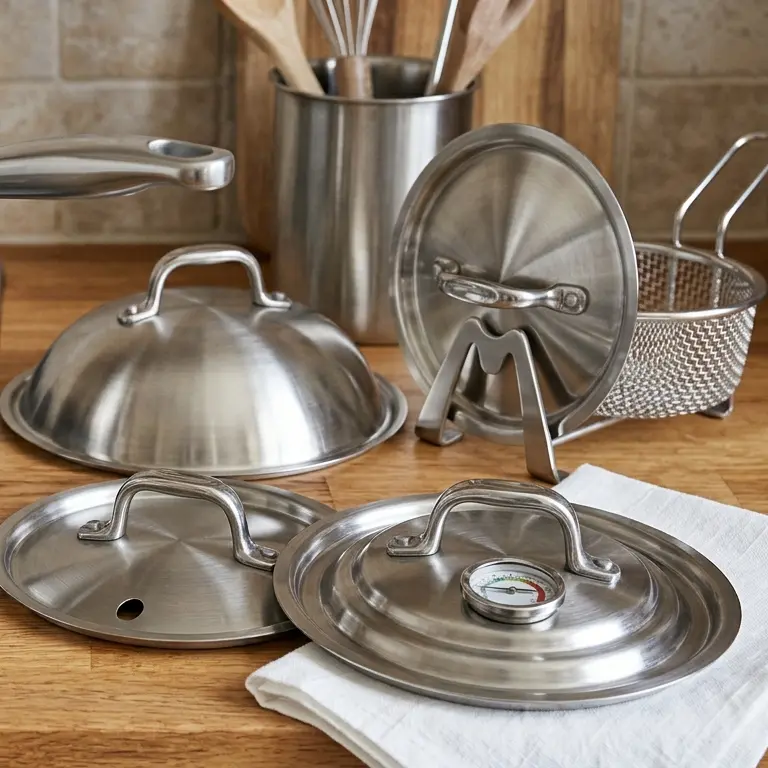
Specify whether the product includes a stainless steel lid, glass lid, steamer insert, basket, or other accessories. Record the relevant materials, dimensions, quantities, and compatibility requirements.
If lids must fit interchangeable cookware sizes, define the matching dimensions and fit requirements on the technical drawing.
3. Surface Finish

Common stainless steel finishes include mirror polish and brushed finishes. The correct choice depends on product positioning, appearance, cleaning expectations, and cost.
Instead of writing “polished finish,” identify the required finish for each component and document the acceptable appearance.
For private-label projects, an approved reference sample or finish sample is particularly useful. Agree on how to evaluate visible scratches, dents, polishing marks, discoloration, and other surface defects. If a numerical roughness requirement is necessary, specify the applicable measurement method and target value.
What Packaging Specifications Should Wholesale Buyers Confirm?
Packaging specifications should define individual product protection, retail presentation, carton configuration, labeling, and shipping requirements. These details affect product condition on arrival, warehouse handling, retail readiness, and total logistics costs.
Before placing an order, confirm the following:
| Packaging Item | Details to Confirm |
|---|---|
| Individual packaging | Polybag, protective sleeve, paper wrap, or retail box |
| Oberflächenschutz | Measures to prevent scratches and contact damage |
| Inner packaging | Quantity and arrangement of products |
| Master carton | Dimensions, material, and packing quantity |
| Product labels | SKU, barcode, product details, and required warnings |
| Markenbildung | Logo placement, artwork, colors, and printed materials |
| Shipping protection | Separation, cushioning, and carton protection |
| Carton identification | Carton numbers, quantities, and shipping marks |
For customized orders, approve packaging artwork and a packaging sample before mass production. Confirm that the packed product fits the agreed carton dimensions and that the packing arrangement protects handles, lids, and polished surfaces.
Buyers selling into different markets should also verify applicable labeling, packaging, and product compliance requirements. These requirements depend on the destination market and product category.
How Can You Turn Cookware Specifications Into a Reliable Bulk Order?
The most effective approach is to convert the specification sheet into a controlled purchasing document that the buyer and manufacturer approve before mass production. This document should connect the quotation, technical drawing, approved sample, inspection criteria, and final order.
Follow these five steps:
- Prepare the specification sheet. Define the product type, material grades, thicknesses, dimensions, capacity, weight, handles, finish, accessories, and packaging.
- Request a quotation against the same requirements. Ask each supplier to identify deviations, proposed alternatives, tooling charges, minimum order quantities, and lead times.
- Review the technical drawing and sample. Verify critical measurements, fit, construction, appearance, and product functionality.
- Approve inspection criteria in writing. Define critical defects, major and minor defects, measurement methods, and the sampling plan where applicable.
- Freeze the approved specification before production. Ensure the purchase order references the approved drawing, sample, packaging artwork, and any agreed revisions.
For formal lot inspection, buyers can consider an appropriate sampling plan based on ISO 2859-1:2026. The standard provides acceptance-sampling schemes indexed by acceptance quality limit (AQL). The parties must still agree on the applicable inspection level, defect classifications, acceptance criteria, and sampling plan; an AQL value alone does not define product quality.
A Practical Specification Sheet: An Often-Missed Purchasing Detail
One common source of disputes is a mismatch between the approved sample and the written specification. A sample may look correct, but it cannot communicate every hidden material requirement, dimensional tolerance, or packaging detail.
To reduce this risk, create a specification-to-sample cross-reference. Assign each critical requirement an ID, such as MAT-01 for material grade, DIM-01 for rim diameter, FIN-01 for surface finish, and PKG-01 for packaging. Link each ID to its drawing reference, verification method, and acceptance criterion.
This simple method gives buyers and manufacturers a shared checklist for sample approval, production inspection, and future repeat orders. It is especially useful for OEM/ODM projects involving multiple cookware sizes or product variations.
What Should Buyers Include in a Stainless Steel Cookware RFQ?
A complete request for quotation (RFQ) should include the specification sheet, drawings or reference images, estimated order quantity, target market, packaging requirements, and customization needs. It should also ask the supplier to identify any deviations from the requested specifications before pricing the order.
Use this final checklist before sending your inquiry:
- Product type, model, and intended application.
- Material grade for each relevant component.
- Body thickness, base thickness, and construction.
- Capacity, diameter, height, weight, and tolerances.
- Handle design, attachment method, and lid configuration.
- Surface finish and acceptable appearance.
- Packaging, labeling, and branding requirements.
- Quality inspection and sample approval criteria.
- Order quantity, destination market, and delivery requirements.
- Required documents, compliance evidence, and customization details.
The more clearly these requirements are defined, the easier it becomes to compare quotations on an equivalent basis instead of choosing a supplier based on unit price alone.
Häufig gestellte Fragen
Q1. What are the most important stainless steel cookware specifications?
The most important specifications are material grade, body and base thickness, dimensions, capacity, weight, construction, handle attachment, surface finish, and packaging. Buyers should also define critical tolerances and inspection criteria before approving samples or bulk production.
Q2. What thickness should stainless steel cookware have?
There is no single thickness suitable for every cookware product. The appropriate value depends on product type, diameter, material, base construction, intended use, and target price. Buyers should specify body and base thickness separately and agree on acceptable tolerances with the manufacturer.
Q3. Is 304 stainless steel always better than 201 stainless steel for cookware?
No. Grade selection depends on corrosion resistance requirements, operating conditions, product positioning, and cost. Buyers should select the grade that meets the intended application and verify the material requirements for relevant food-contact uses.
Q4. Why are dimensional tolerances important when buying cookware in bulk?
Tolerances define how much a finished dimension may deviate from its target value. They help ensure consistent lid fit, stacking, component compatibility, and packaging dimensions while giving both parties an objective basis for inspection and acceptance.
Q5. What should I send a manufacturer to get an accurate cookware quotation?
Send a product specification sheet, technical drawings or reference images, target quantities, material and construction requirements, packaging details, branding needs, and destination market. Include the required tolerances and inspection criteria, and ask the supplier to identify any proposed deviations.
Q6. Can Allnice customize stainless steel cookware specifications for OEM/ODM orders?
Yes. Allnice offers OEM/ODM kitchenware solutions, including product design, mold development, logo customization, packaging, and bulk production. Buyers can share their required product dimensions, materials, finishes, and order quantities to discuss a suitable customized solution.
Schlussfolgerung
Clear stainless steel cookware specifications help buyers compare suppliers fairly, control product consistency, and reduce avoidable revisions before bulk production. By documenting material grades, thickness, dimensions, tolerances, handles, surface finishes, and packaging, you can turn purchasing expectations into measurable manufacturing requirements.
Allnice is a trusted kitchenware manufacturer specializing in wholesale stainless steel cookware, tableware, and catering equipment for global importers, wholesalers, distributors, and private-label brands. With OEM/ODM services covering product design, mold development, logo branding, packaging customization, and bulk production, Allnice provides one-stop solutions for diverse business needs. Contact Allnice today to discuss your cookware specifications, request a quotation, and develop products tailored to your market.